We measured what monitoring costs to run
Svitgrid connects to your inverter three ways: a small box that stays plugged in; a phone of your own that stays at home with Svitgrid open, reading the inverter itself — the mobile harvester; or Home Assistant, if you already run it. We measured the first two, because they are the two you can put on a meter. They differ by a factor of fourteen — and that is the least important thing the measurement shows.
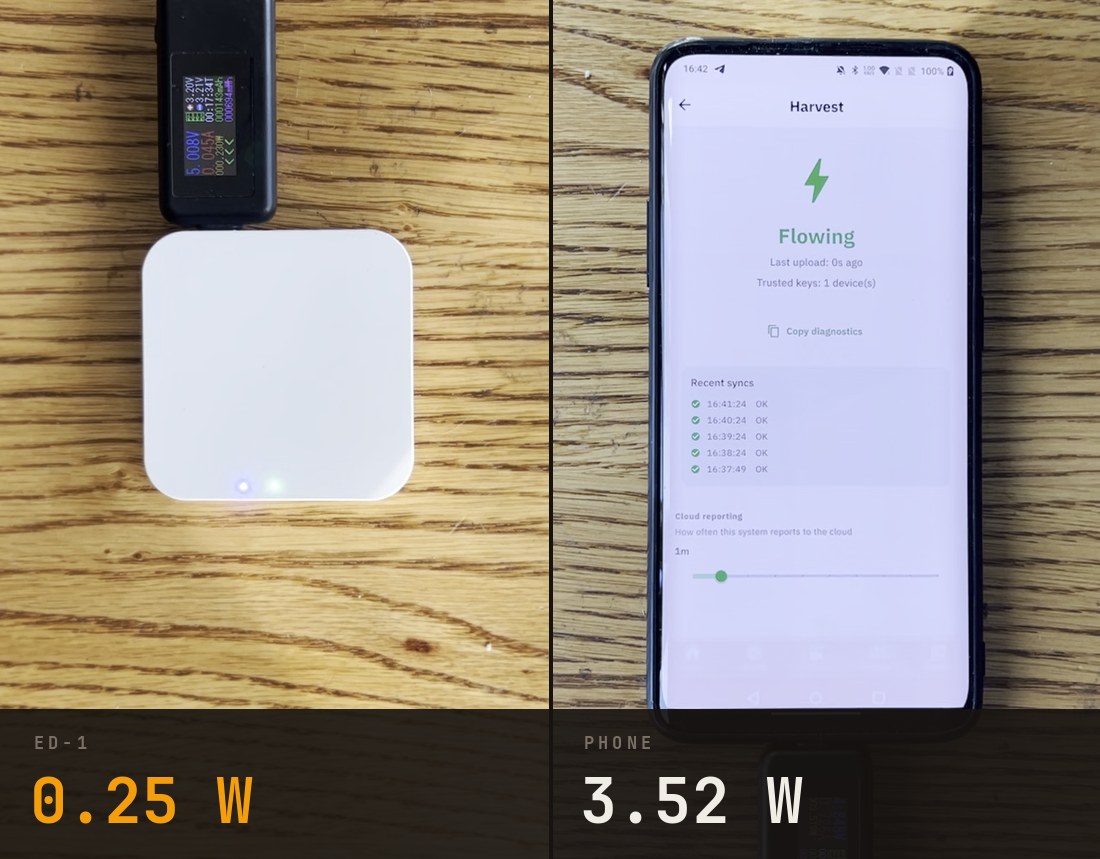
How we measured it
One USB power meter, in line between the charger and the device under test. First the ED-1 Edge Connector, then an Android phone with the Svitgrid mobile harvester open. Both were doing their normal work throughout: reading an inverter and uploading readings to the cloud.
The number we used is not the watts on the display. Instantaneous watts move around, and picking a moment is picking an answer. The meter also totals milliwatt-hours, so we read that total at the start and at the end and divided by the time between them. On both recordings the window is the same 9 minutes 57 seconds, timed by the meter’s own clock.
The two devices ran one after the other rather than side by side, because there was one meter. That is worth knowing, and it is also why the window was matched to the second.
| ED-1 | Phone | |
|---|---|---|
| Energy over ten minutes | 0.041 Wh | 0.583 Wh |
| Average power | 0.25 W | 3.52 W |
| What that adds up to in a year | 2.2 kWh | 30.8 kWh |
| In money, per year (4.32 UAH/kWh) | 9 UAH | 133 UAH |
Now the honest part about money
The difference is 28.6 kWh a year. At the standard Ukrainian household rate of 4.32 UAH per kWh, that is about 124 UAH a year. An ED-1 costs 999 UAH. On electricity alone it pays for itself in roughly eight years, which is not an argument for buying anything.
So the watts are not the case for a dedicated device. They are only the first thing a meter can see. The real cost of the phone is the phone.
A phone that harvests cannot do anything else
The screen stays on. The harvest screen keeps the phone awake for as long as it is open. That is deliberate — it is what keeps the phone awake — and it is also most of the 3.52 W. A screen is not overhead you can optimize away; it is the phone doing what a phone does.
Leaving the app stops the collection. Switch away from Svitgrid and collection stops. Answer a call, check a message, let the phone lock, and the readings stop until somebody opens Svitgrid again.
Taking the phone with you stops it too. The harvester reads the inverter across your home network. Walk out of the house and there is no route to the inverter any more.
Put together, this is not your phone. It is a second phone, lying next to a socket with its screen lit, doing one job. And while it is doing that, it cannot be used for anything else.
What a purpose-built device does instead
It comes back on its own. After a power cut the ED-1 boots and carries on. Nobody has to unlock a screen or reopen an app.
It remembers what it could not send. The device has a memory of its own, and a reading goes into it before the device tries to send it. A reboot or an internet outage therefore loses nothing: about a day of readings wait inside and go up as soon as the connection returns.
It has nothing to interrupt it. No calls, no notifications, no operating-system update at three in the morning, no screen for anyone to turn off.
This is the whole argument, and it is not really about watts. A device built for one job holds that job through the events that make a phone stop.
When the phone is still the right answer
The mobile harvester is not being retired. It is how you try Svitgrid today with no hardware at all, how you keep reading your inverter while a board is in the post, and how you cover an installation where there is nowhere to put a box.
If you already run Home Assistant, that is the third way. It can be your collector too, and it is absent from this comparison for a plain reason: there is nothing to measure. It is an integration running on a computer you already leave switched on, so it has no draw of its own — its draw is already part of that computer's.
An old phone already sitting in a drawer is a reasonable way to run it. Know what you are committing it to: it is on, awake and in one place from then on.
Watch the two meters run
Ten minutes of each recording, side by side, at eight times speed. The meters in shot are the measurement; the panel on the left counts up the energy each side has used since the start.
Order one
Ships via Nova Poshta within Ukraine. International orders are arranged individually.
from 999 ₴
The one in the measurement is ED-1, which reads the inverter through the WiFi stick already fitted to it; that is 999 UAH. There is also ED-1.1 at 1400 UAH, for an inverter that has no such stick, or whose stick has stopped giving up its data.
Telling which one you need takes a minute. Open your inverter manufacturer's own app on your phone — Solarman, FusionSolar, or whichever came with the system. If your system appears there, you want ED-1. If it does not, or there is no such app, you want ED-1.1. The Gateway page lays that choice out next to the prices.
The app needs a paid plan, bought inside Svitgrid on your phone. It starts at $1 a month, with a 14-day free trial.
Choose on the Gateway pageEvery change in the app and the firmware, line by line.
Open the changelog →